
Blossom Winchester
Writer of Gothic Fiction & Folk Tales
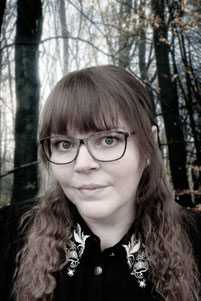
Blossom Winchester writes modern folklore, fantasy, poetry, and gothic-tinged stories about living landscapes, stubborn love, and the things that refuse to stay buried. She is also the author of previously published fantasy novels. Her work moves between the eerie and the intimate, lingering in old houses, along tree lines, and at thresholds where the ordinary world thins just enough to let something older breathe through.
She lives in a small village in Germany with her husband and her two rescue dogs, Nova and Gwyn, who rarely leave her side while she writes.
Alongside storytelling, Blossom is also a visual artist working in pyrography, ink, and watercolor, drawn to materials that carry scorch marks, grain, texture, and memory. Hedgecraft, animism, and folklore are not themes she adds to her work, but part of how she moves through the world. She believes that trees, stones, and houses hold stories of their own, and that writing is one way of answering back.
Meeting Otherworld NEWS
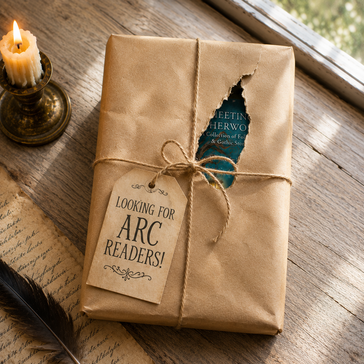
Meeting Otherworld – Coming August 2026
Meeting Otherworld is my current work in progress, a collection of short stories that wander the borders between our world and the realm of the Fae. Some tales are steeped in old folklore, others unfold in the present day—but all carry the timeless tone and magic of Otherworld.
ARC READERS WELCOME!
Join the Circle
Step a little closer to the veil.
Subscribe to receive updates on the release of Meeting Otherworld, exclusive poems, occasional short stories, and reflections on folklore, the liminal, and the unseen. You'll also be the first to hear about new books, projects, and the stories still waiting to be told.
The Becoming Of Meeting Otherworld
Folklore and gothic fiction do not always walk in straight lines. They linger. They whisper. They allow silence to speak as loudly as action. Sometimes they pause a moment longer than expected. Sometimes they leap ahead and leave the reader to follow.
Writing these stories gave me permission to experiment—not simply with plot, but with atmosphere, pacing, and uncertainty. To write stories that are quieter, stranger, and perhaps more honest in their own way. These are not stories that rush to explain themselves, but they invite you to sit for a while in the half-light. And sometimes, if we linger long enough in those liminal spaces, we begin to encounter questions we had not intended to ask ourselves.
Perhaps that is why folklore and gothic tales have always unsettled us. They don’t always show us monsters, but they are eager to hold up a lantern and ask us to look more closely at ourselves.