
House Spirits, Hearth Traditions, and the Old Ways of Keeping Peace at Home
Sometimes the unseen makes itself known in very ordinary ways.
A while ago, I lost the wind protector for my microphone; the little “dead cat,” as it’s called. Of course this happened just before a big trip. Now, I am not someone who misplaces things. Everything has its home, especially equipment like that. I searched the camera bag, the car, the office.
Nothing.
After hours of turning things inside out and with departure approaching, I stopped searching. I paused and left a small bowl of milk and honey near the kitchen stove—something I had meant to do before we left anyway— and let the matter rest. A few hours later, when I opened my camera bag once more, the wind protector was there. In its usual place.
Coincidence, perhaps. Or perhaps a reminder that homes are not inert spaces, and attention matters.
That is where this conversation begins.
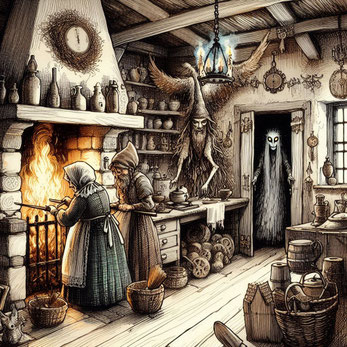
Old Spirits in New Houses
Every land has its own tales of the beings who dwell with us; protectors, tricksters, quiet watchers of hearth and threshold. In German folklore, there are references to beings sometimes called the Drak (or Drache), though accounts vary by region. In some traditions, the Drak was described as a fiery, serpentine household spirit associated with wealth and protection. In others, it blurred into stories of Kobolds or helpful but temperamental domestic spirits.
What remains consistent across regions is this: the idea that a household could acquire a spirit presence tied to its prosperity and wellbeing — and that this presence required proper conduct.
Across Europe, similar figures appear under different names:
- the Brownie in Scotland
- the Kobold in German-speaking regions
- the Tomte or Nisse in Scandinavia
- the Domovoi in Slavic lands
While the stories differ, they share a common thread: the home is not considered spiritually empty. It is inhabited not only by the living, but by memory, presence, and relationship.
Stories of domestic spirits are not fringe inventions. They appear in 19th-century folkloric collections across Germany, Scandinavia, Scotland, and Eastern Europe — recorded not as fantasy, but as common rural belief. Jacob Grimm himself noted household spirits in his Deutsche Mythologie, describing them as beings bound to hearth and dwelling rather than to wild land.
This doesn’t make every creaking floorboard supernatural. But it does remind us that the idea of a living household is older than modern scepticism.
But what of modern houses — concrete walls, new timber, electric light instead of hearthfire?
Older folklore does not suggest that spirits were tied only to medieval beams or peat smoke. Many traditions held that domestic spirits attached themselves not just to buildings, but to households and to families, to patterns of care, and continuity. When people moved, sometimes the spirit was believed to move with them. In other cases, a new house would gradually “grow” its own presence through repeated living: cooking, sleeping, arguing, reconciling.
In that sense, it is less about the age of the structure and more about relationship.
A home becomes inhabited over time and not only by those who pay the mortgage.
Clarifying: House Spirits vs. Faery Beings
It is important not to blur categories carelessly. House spirits and the Good Neighbours are not always the same.
House spirits are typically bound to place, to the structure, the hearth, the lineage of those who live there. They are domestic presences, concerned with order, maintenance, and harmony within the household.
Faery beings in older lore are more often tied to land, mound, water, forest, or ancestral territory. They are not “household helpers,” and they are not automatically benevolent.
The overlap comes in practice, not identity.
Offerings of milk or bread appear in both traditions, but intention differs. With house spirits, the relationship is reciprocal and domestic. With faery beings, the relationship is cautious and boundary-aware.
Not every flicker of movement in a home belongs to the same category. Discernment matters.
Listening to the Quiet Ones
When I enter a home as a House Healer, I don’t only sense its energy. I listen. Each house hums with personality, shaped by the lives within it, by time, by care. And sometimes, there’s another note in the harmony: a presence that watches, waiting for acknowledgment. House spirits often show themselves through small things like misplaced keys, flickering lights, a certain spot that feels oddly alive. But more often, they speak through feeling. When the home feels heavy, stagnant, or restless, it may be that its unseen keepers are calling for attention. It doesn’t take much to rekindle peace. A bowl of milk, a crumb of bread, a whisper of appreciation before bed. They like simple gestures offered with sincerity.
House Healing work should not be about dramatic clearing or theatrical ritual, even if this is quite common these days. House Healing work is about identifying stagnation, repairing energetic boundaries, and helping the inhabitants re-establish a healthy relationship with their space.
I spoke more about this at the International Network of House Healers’ conference; how to sense these presences, how to honor them, and how to know when they seek your notice. My talk starts at 03:40:20 You can watch it here:

An Old Hearth Custom
In many parts of Europe, especially in rural Germanic and Slavic regions, it was customary to “feed the hearth” before a journey or at the start of a new season. A small portion of food would be placed near the stove, fireplace, or threshold.
Often it was:
- A piece of plain bread
- A small bowl of milk or cream
- Porridge or grain
It was left quietly overnight. No elaborate words were spoken. In many homes, nothing was said at all. The act itself acknowledged:
The house shelters us. We maintain good standing within it.
In the morning, the offering was removed and returned to the earth.
This practice was less about gratitude and more about maintaining right relationship.
You can still do this today.
Before leaving for travel, after an argument, at the turning of a season, break a small piece of bread. Set it quietly near the kitchen or by the threshold.
You can either say: “For peace between us.” or say nothing and place it quietly.
Then leave it overnight. In the morning, return it to the earth.
Homes remember when they are treated as living places.
Hearth Blessing
The Hearth Blessing is not a spell to command.
It is best spoken in ordinary moments:
- before leaving for a journey
- after illness or conflict in the home
- when moving into a new place
- at the turning of a season
- or simply when the house feels unsettled
Place a small piece of bread or a little cream near the hearth, stove, or threshold. Stand quietly and speak the blessing once slowly. No need to repeat it excessively. No need to dramatize it. In the morning, remove the offering and return it to the earth. The purpose is not to summon anything new, but to maintain right order within what already dwells there.
“Bread for the beam,
cream for the stone,
peace in the hearth
and harm overthrown.
Flame that warms us,
guard this floor.
Good be within,
and ill at the door.
By crumb and fire,
by night and day,
keep what is ours
in rightful way.”
Closing Thoughts
Whether one interprets house spirits literally, symbolically, or somewhere in between, one truth remains: homes respond to attention. A house that is spoken to, cleaned with intention, repaired with care, and acknowledged as more than shelter begins to feel different. Lighter. Ordered. Cooperative.
Old traditions understood this instinctively. They treated the hearth as a center, the threshold as a boundary, and daily gestures as acts of maintenance, not superstition.
You do not need to believe in unseen beings to practice respect. But if you have ever felt a home grow heavy after conflict, or brighten after reconciliation, then you already understand something of what our ancestors meant.
If your home feels unsettled, stagnant, or simply tired, my House Healing work is available to help restore balance in a grounded and practical way.
And if you are drawn to the old stories, the quiet presences that linger at hearth and beam, you will find more of them woven through my writing and art at Wildweave Creations.
May your house stand steady.
May your threshold hold firm.
And may what dwells within your walls remain in right order.
With hearthfire blessings,
Write a comment